
The short answer
An isolating valve, also called a service valve, is a small quarter-turn valve on the pipe to one tap, toilet or appliance, so you can work on it without turning off the whole house. Slot or lever across the pipe is off; in line is on. Match it to the pipe (15mm or 22mm), choose compression or push-fit ends, and use full bore where flow matters. The water regulations expect one before every cistern's float-operated valve.
What is an isolating valve?
An isolating valve — also called an isolation valve, service valve or servicing valve — shuts off the water to one fitting. Inside is a small ball with a hole through it: a quarter turn lines the hole up with the pipe (open) or turns it across the pipe (closed). They're small, cheap and quick to fit, so plumbers routinely put them under taps, toilets and appliances.
Is it open or closed? Look at the slot or lever: in line with the pipe is open, across the pipe is closed.
Slotted, lever or ball valve: which type?
| Type | How you turn it | Best for |
|---|---|---|
| Slotted (screwdriver operated) | A flat screwdriver, a quarter turn | Under basins, sinks and toilets — tidy, and hard to knock off by accident |
| Lever or handle | By hand, a quarter turn | Valves you'll turn often or can't get a screwdriver to, such as an outside tap supply |
| Appliance valve | Blue or red lever, a quarter turn | Washing machines and dishwashers, with a 3/4" BSP hose thread on the outlet |
| Lever ball valve | A full-size lever, a quarter turn | Main runs in 22mm and 28mm, and isolating a whole branch or floor |
| Gate valve | A wheel handle, several turns | Low-pressure pipes from a loft tank, where a full-bore valve helps |
Isolating valves come in chrome for show and plain brass for out of sight, straight or angled. Yellow-handled valves and Isogas cocks are for gas, not water — any gas work must be done by a Gas Safe registered engineer.
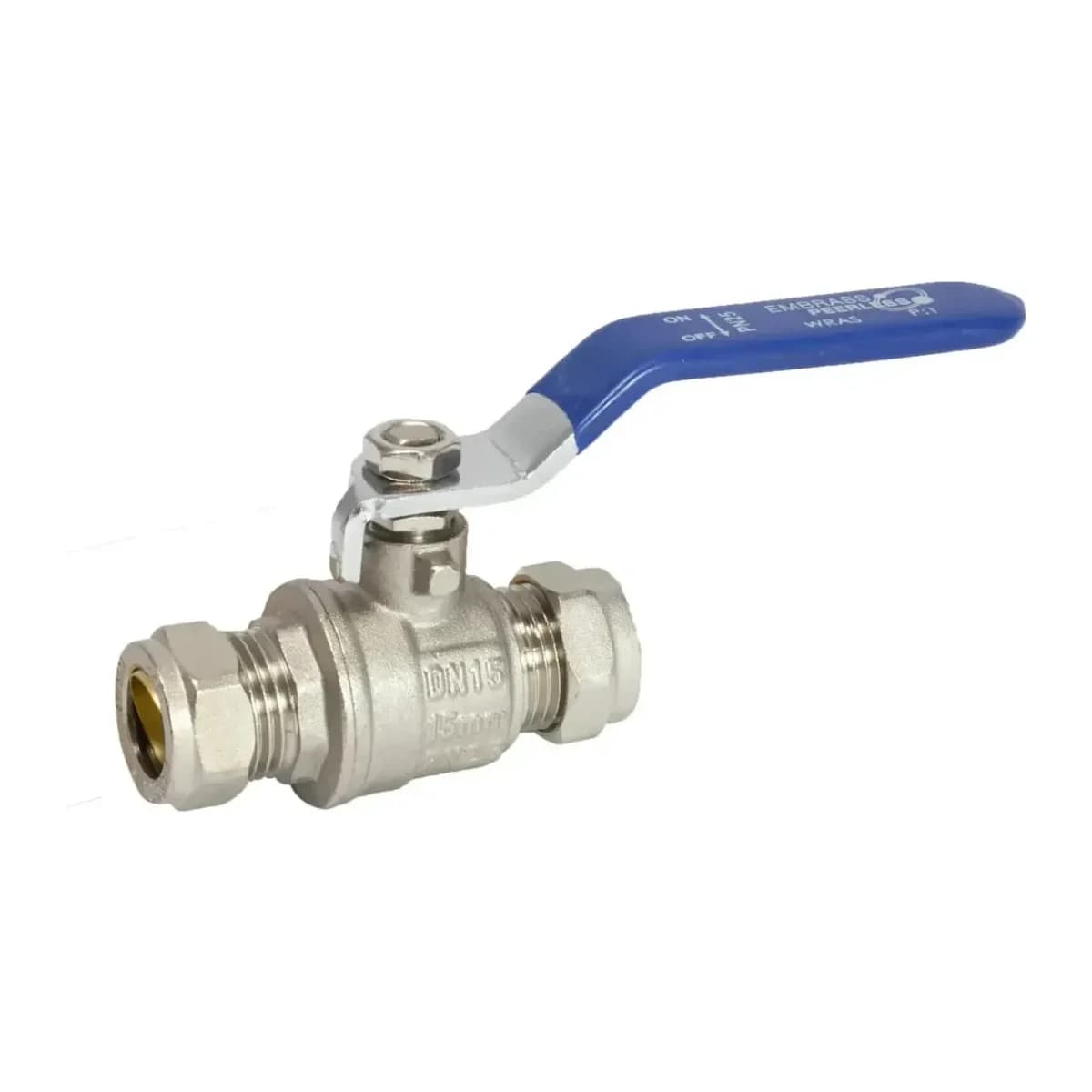 In stockLever Ball Valve Compression (WRAS Approved) Blue Handle C x C
6 sizes available
Frominc VAT£5.25 ex VAT
✓ Delivery available✓ Collect today
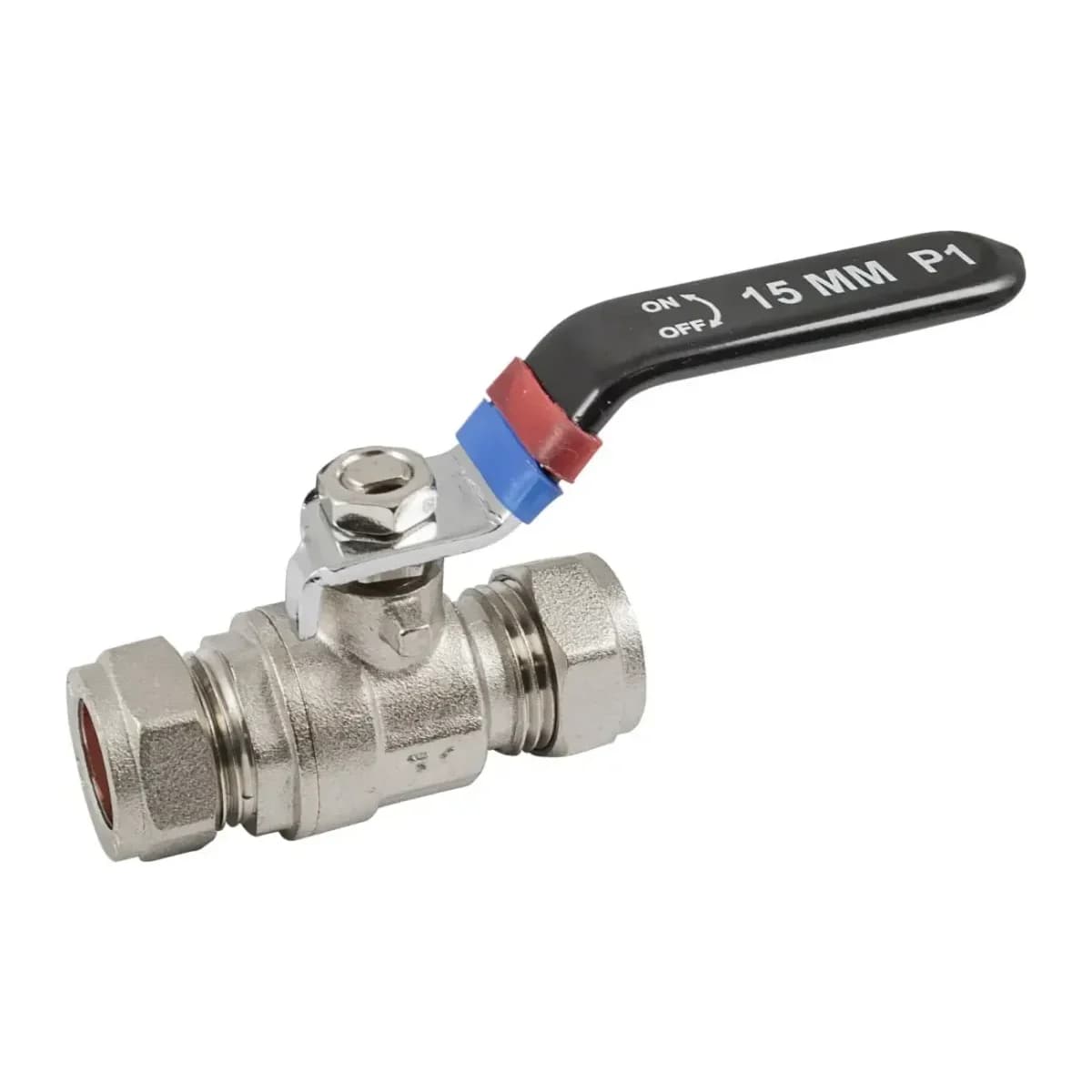 In stockLever Ball Valve Compression Black Handle c/w Red & Blue Bands C x C
3 sizes available
Frominc VAT£5.25 ex VAT
✓ Delivery available✓ Collect today
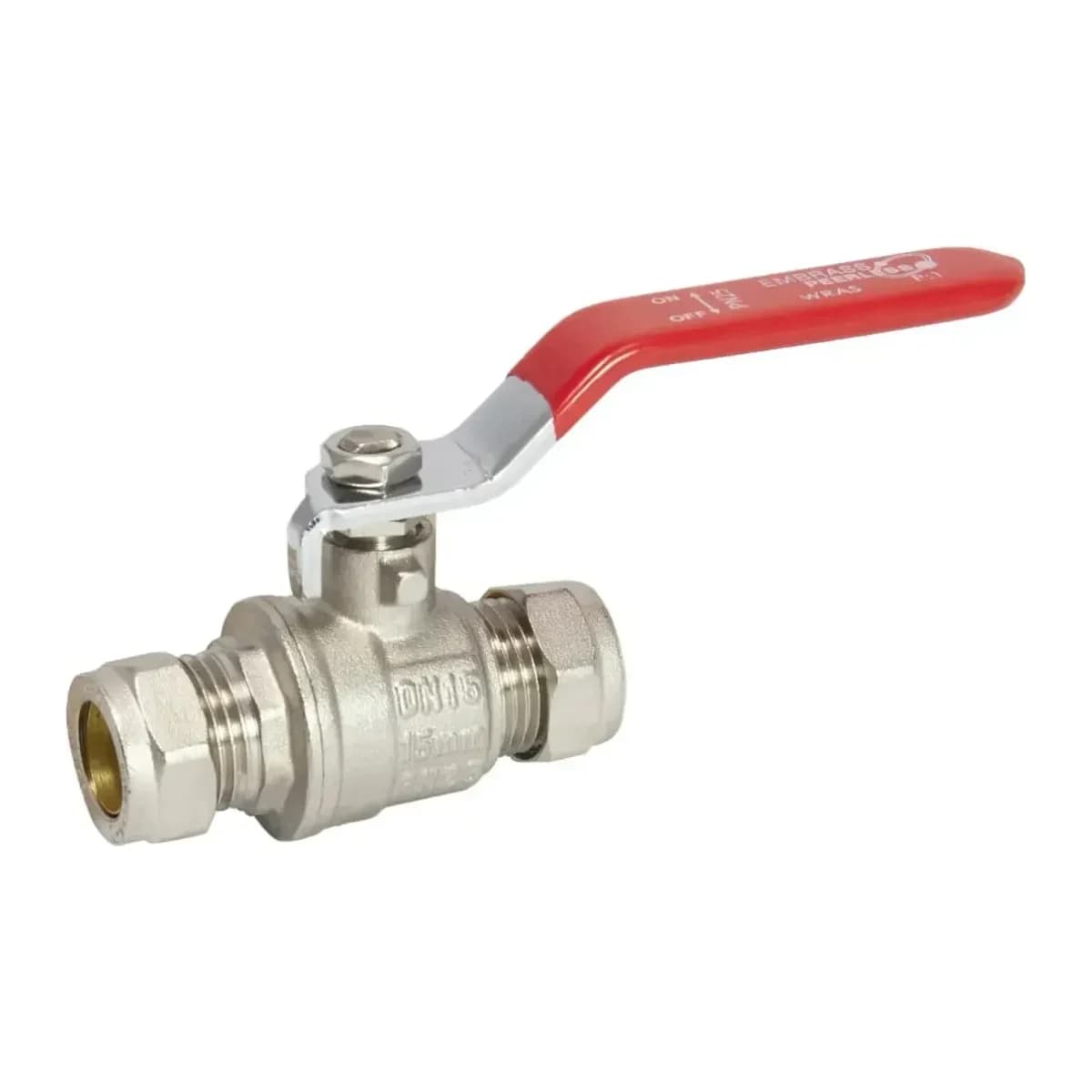 In stockLever Ball Valve Compression (WRAS Approved) Red Handle C x C
6 sizes available
Frominc VAT£5.25 ex VAT
✓ Delivery available✓ Collect today
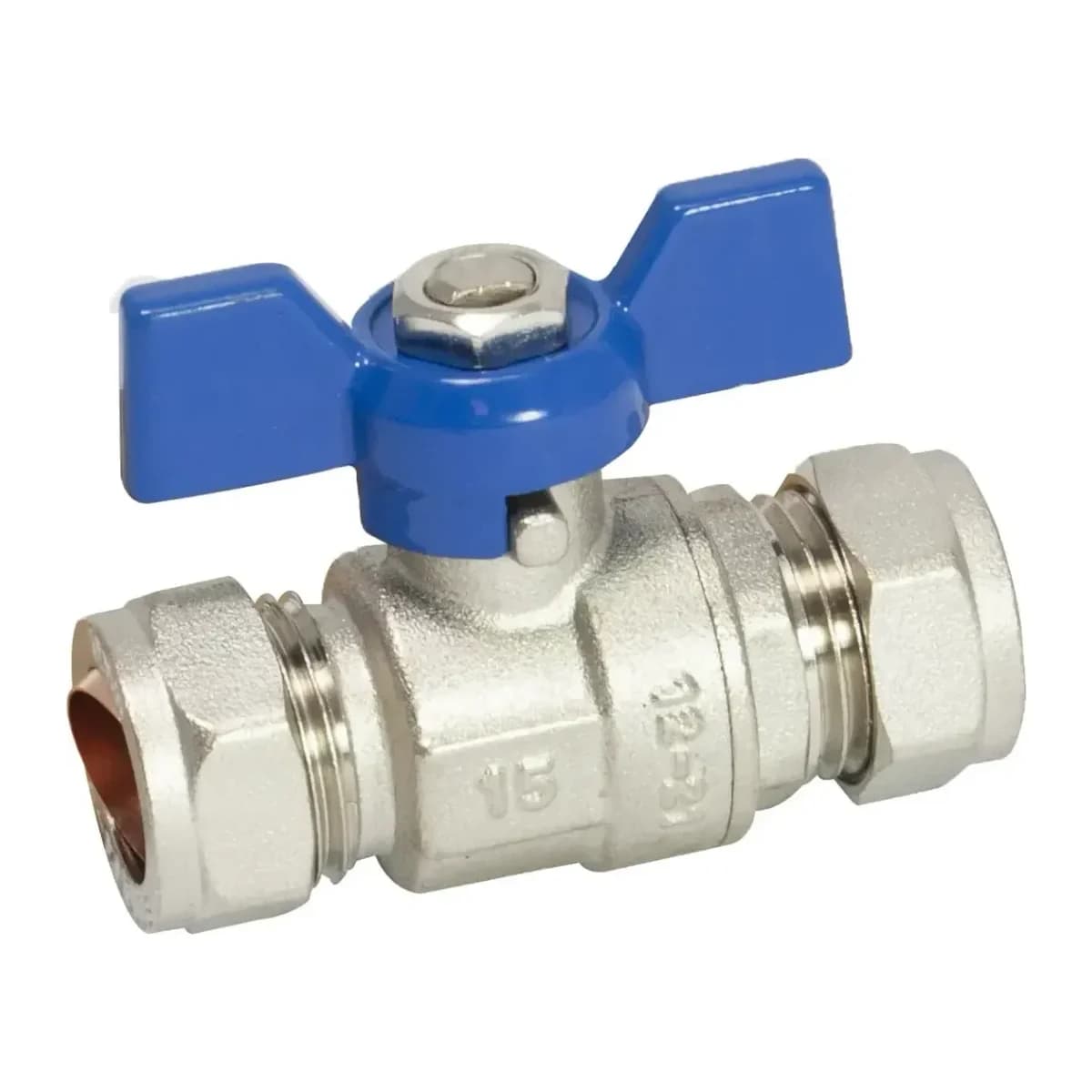 In stockButterfly Ball Valve Blue Handle C x C
4 sizes available
Frominc VAT£6.46 ex VAT
✓ Delivery available✓ Collect today
Compression, push-fit or threaded ends?
The ends need to suit the pipe on one side and whatever you're connecting on the other:
- Compression (C x C): a nut and olive each end, for copper, or for plastic pipe with an insert. The most common, and it can be undone. See compression vs push-fit vs solder.
- Push-fit: pushes on to copper or plastic pipe, with no spanners; makers such as Polyplumb and JG Speedfit make them to match their systems.
- Compression x swivel nut: the nut screws straight on to a 1/2" BSP tail — a toilet fill valve or a tap — so you don't need a separate connector, as on our 15mm x 1/2" service valve.
- Compression x flat-faced male thread: a 1/2" or 3/8" BSP male end with a flat face that seals against the washer in a flexible connector's nut without cutting it, as on our 15mm x 1/2" flat-faced valve.
- Female thread (FI): screws on to a male BSP thread.
- Valve built into a flexible connector: a flexi tap connector with isolating valve puts both in one part, handy under a basin where space is tight.
Not sure which thread you have? Our BSP thread sizes guide shows how to measure it.
Full bore or reduced bore?
Many standard isolating valves have a hole through the ball that's smaller than the pipe, which costs some flow. On mains pressure — a combi or unvented cylinder — that rarely shows at a basin or toilet. It does matter on:
- Tank-fed (gravity) supplies, where there's very little pressure to spare — see low water pressure: taps and showers.
- High-flow outlets such as bath taps and large shower heads.
- Anywhere a manufacturer asks for full-bore valves — shower pump makers often do.
Full-bore valves keep the same bore as the pipe. They're a little bigger and cost a little more, and they're labelled full bore.
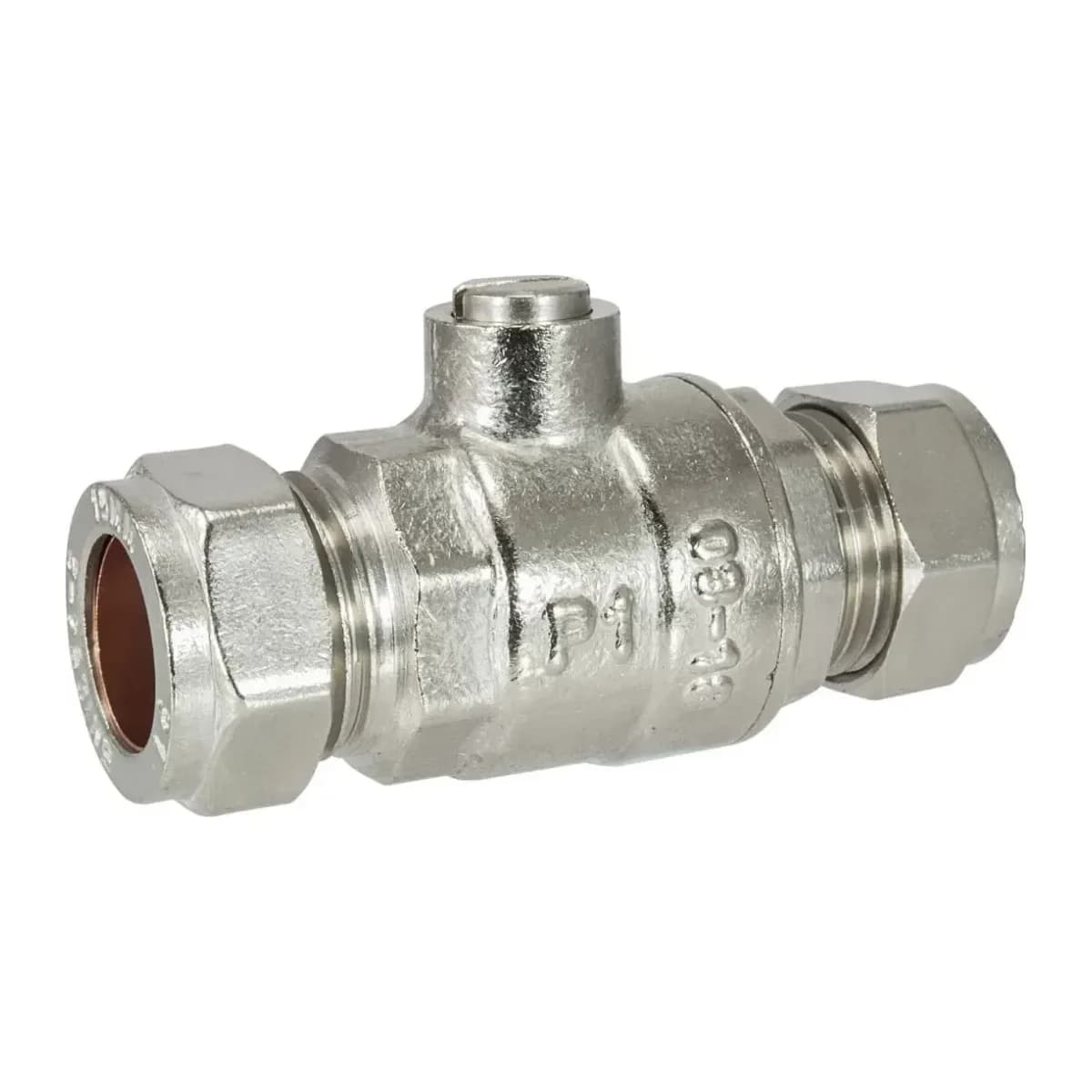 In stockIsolating Valve Full Bore
3 sizes available
Frominc VAT£2.44 ex VAT
✓ Delivery available✓ Collect today
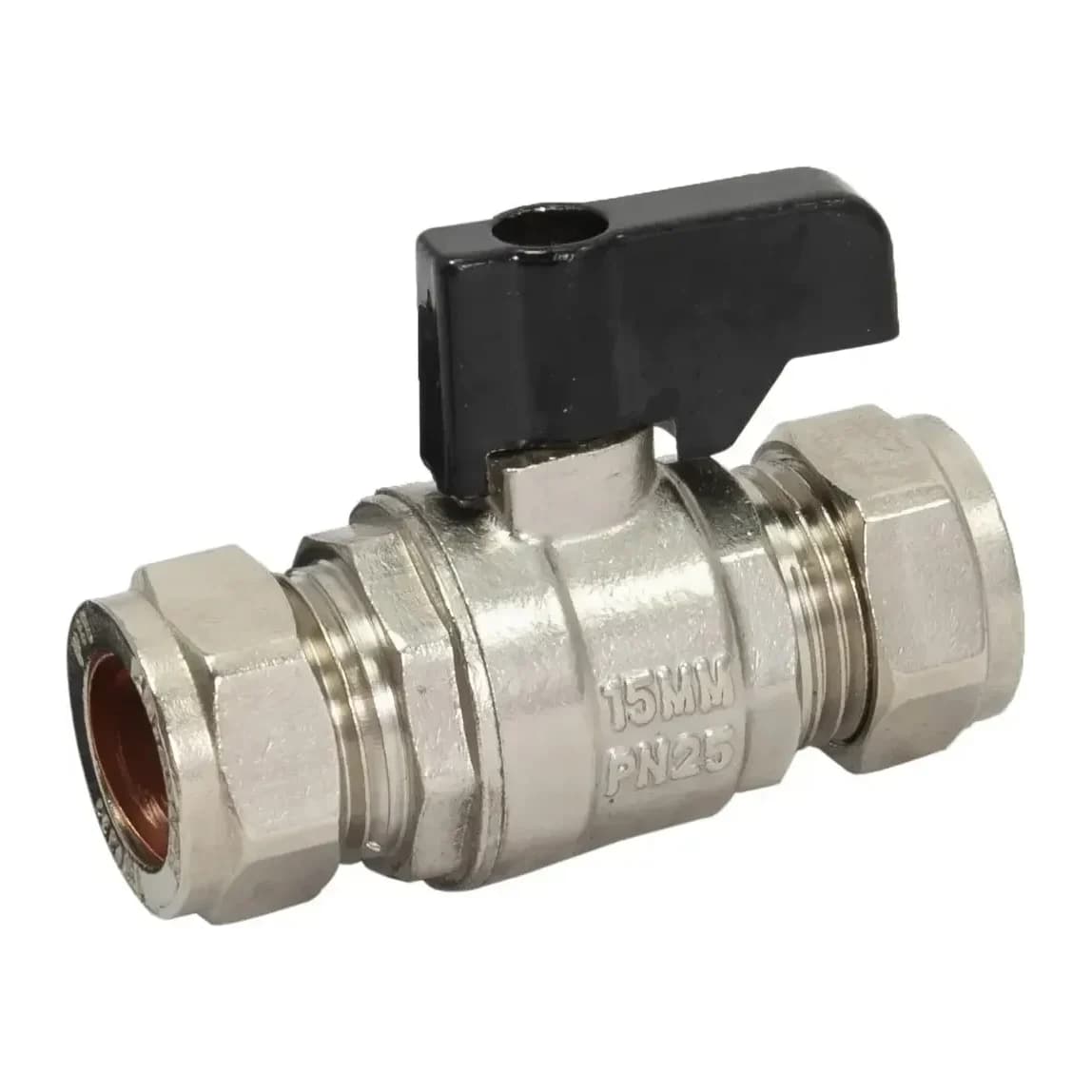 In stock15mm Full Bore Isolation Valve with Handle
Code: LP-KII6VA
inc VAT£3.68 ex VAT
✓ Delivery available✓ Collect today
Where do the water regulations want an isolating valve?
The Water Supply (Water Fittings) Regulations 1999 (Scotland has equivalent byelaws) require fittings to be accessible for maintenance, and their guidance calls for servicing valves in particular places:
- Every float-operated valve — the fill valve in each toilet cistern, and the float valve in a loft tank — needs a servicing valve as close as practicable to its inlet.
- Outlet pipes from a storage cistern, other than warning and overflow pipes, should have one close to the cistern, so the tank-fed pipes can be isolated without draining the tank.
- Appliances and water-using equipment — washing machines, dishwashers, water heaters, water softeners — should be fitted so they can be isolated for maintenance.
- Taps aren't specifically listed, but a valve under each one is good practice and makes every future repair easier.
Keep valves where you can reach them — not buried behind tiles or boxing; fit an access panel if you have to. And use fittings that are suitable for drinking water: WRAS approval is the usual way to show a product meets the regulations.
Which size isolating valve do I need?
| Where | Valve |
|---|---|
| Basin and sink taps, toilets | 15mm slotted or lever; a 15mm x 1/2" swivel-nut or flat-faced valve to suit the connector |
| Mixer taps with flexible tails | 15mm, or a flexible connector with a built-in valve — check the tail's end first |
| Bath taps | 22mm, full bore on tank-fed systems |
| Washing machine and dishwasher | 15mm x 3/4" appliance valve |
| Outside tap supply | 15mm lever valve indoors, followed by a double check valve |
| A whole branch or floor | 22mm or 28mm lever ball valve |
Measure the pipe across the outside — see 15mm vs 22mm pipe. We stock 40 isolating valves from £1.46, plus appliance valves, ball valves and gate valves.
How to fit an isolating valve
- Turn off the water and drain the pipe — see how to turn off your water supply.
- Hold the valve against the pipe and mark where to cut, allowing for the pipe that goes into each end. Cut square with a pipe cutter and deburr.
- Slide a nut and olive on to each pipe end, with an insert in plastic pipe.
- Fit the valve, with any flow arrow pointing the way the water runs, and tighten each nut hand-tight plus about a half to three-quarters of a turn, holding the valve body with a second spanner.
- Close the valve, turn the water on and check for drips; then open it and check again.
Turn your isolating valves now and then. A valve that's never moved can stiffen with scale and be stuck just when you need it.
Questions
- Is an isolating valve open when the slot is in line with the pipe?
- Yes. In line with the pipe is open; across the pipe is closed. The same goes for lever valves.
- What's the difference between an isolating valve and a service valve?
- Nothing — they're the same thing. The regulations call them servicing valves; the trade says isolating valve, isolation valve or service valve.
- Do isolating valves reduce water pressure?
- Standard ones restrict the flow slightly because the hole through the ball is smaller than the pipe. It rarely shows on mains pressure; on tank-fed supplies, use full-bore valves.
- Do I need an isolating valve on a toilet?
- Yes. The water regulations call for a servicing valve on the inlet to every float-operated valve, which includes a toilet cistern's fill valve.
- Can I use an isolating valve on gas?
- Only a valve made and marked for gas — usually yellow-handled. Any gas work must be done by a Gas Safe registered engineer.
- Why is my isolating valve leaking?
- If it's at the nuts, the olive needs nipping up or replacing. If it's round the slot or spindle, the valve's internal seal has worn, so replace the valve.