
The short answer
Turn the water off at the stop tap, switch off the boiler, keep clear of any electrics the water has reached, then open the taps to drain the pipe. For a temporary fix, wrap the dry pipe tightly in self-amalgamating tape or a repair bandage. To fix it properly, cut out the damaged section and fit a compression or push-fit repair coupler. A weeping compression joint often needs only a quarter turn; if not, remake it with a new olive.
What to do first
- Turn off the water at the stop tap — usually under the kitchen sink, or where the supply pipe comes into the house. Turn it clockwise until it stops.
- If you have a cold water tank in the loft, the stop tap only stops it refilling: the tank still feeds the hot taps, and often the bathroom cold taps. Close the valve on the pipe out of the tank if there is one; otherwise run those taps to empty it.
- Make the electrics safe. If water is reaching sockets, light fittings or the consumer unit, don't touch them. Switch off at the consumer unit only if you can reach it standing somewhere dry, with dry hands; otherwise keep clear and call an electrician.
- Switch off the boiler and immersion heater if the leak is on hot water or heating pipework.
- Drain the pipe. Open the cold taps, then the hot, to empty the pipework and take the pressure off the leak. Catch drips with a bucket and towels.
- If a ceiling is sagging with water, keep out from under it.
If the stop tap won't turn, don't force it — old ones can snap. In an emergency the water company's stop tap, under a small cover near your boundary, may be an option (it needs a key), or call your water supplier. Afterwards, replace a seized stop tap: we stock 26 stop taps, including a Surestop that turns the water off from a switch.
Find where it's actually leaking
Water runs along a pipe and drips from the lowest point, which can be well away from the leak. Dry the pipe and joints with kitchen roll and run a dry tissue along the pipe until it comes away wet. If you've already drained it, turn the water back on briefly to find the leak, then off again.
| Where it's leaking | Likely cause | Fix |
|---|---|---|
| Compression joint (brass nut) | Nut slightly loose, or the olive damaged or not square | A quarter turn; re-olive if that doesn't stop it |
| Push-fit joint | Pipe not fully home, no insert in plastic pipe, scored pipe or damaged O-ring | Remake it with a clean, square pipe end |
| Soldered joint | Joint not fully filled when it was made, or corrosion | Cut it out and fit a new fitting or coupler |
| Along the pipe | Split from frost, a nail or screw, or a corrosion pinhole | Cut out the damaged length and fit a repair coupler |
| Valve spindle | Worn gland packing | Tighten the gland nut slightly, or replace the valve |
| Flexible tap connector | Worn washer, or a perished or kinked hose | Replace the connector |
Temporary fixes to get you through
A temporary repair buys time until you can fix the pipe properly, or until a plumber arrives. Most work best with the water off and the pipe dry and clean.
- Self-amalgamating tape. A rubber tape that fuses to itself as you stretch it. Wrap it tightly, half-overlapping each turn, from well before the leak to well past it. Our self-amalgamating tape is £6.98.
- A pipe repair bandage. Wrapped round the pipe and left to set hard — follow the pack for preparation and curing time. We stock Pow R Wrap repair bandages from £10.61.
- Epoxy putty. A two-part putty you knead and press over a pinhole or a weeping joint. It needs a dry, clean, roughened surface to stick to.
- A bolt-on repair clamp. A rubber-lined clamp bolted round the pipe over the leak — quick, and good on straight pipe away from joints.
- Leak sealers. An external sealer such as Fernox LS-X can stop a weep at a joint, used as the tube directs. Central heating leak sealer goes into the heating system's water for small leaks that are hard to reach. Heating chemicals never go into drinking-water pipes.
The permanent fix: cut out the damage and fit a coupler
The proper repair for a split, a pinhole or a damaged length is to cut out the bad section and join the pipe again. In a fixed pipe run you can't pull the ends apart, which is why slip couplers exist: a normal coupler has a stop in the middle, but a slip coupler doesn't, so it slides fully onto one pipe end and then back across the cut.
- Turn off and drain the pipe — or freeze it either side of the repair with a pipe freezer (£17.46) so you don't have to drain the system.
- Cut out the damaged section with a pipe cutter. A slice cutter that clips over the pipe works where there's no room to swing a rotary cutter.
- Deburr the ends inside and out and clean them with an abrasive strip. Check for scratches where the olive or O-ring will seal.
- Small damage: make one cut through the hole and slide a compression slip coupler across it. A longer section: cut it out and fit a new piece of pipe with a coupler at each end.
- Mark the pipe so the coupler ends up centred over the joint, with both pipe ends well inside it.
- For compression, fit the nuts and olives, tighten by hand, then about a half to three-quarters of a turn with a spanner while a second spanner holds the body. For push-fit, mark the insertion depth, push each pipe fully home and pull back to check it's gripped.
- Turn the water on slowly, check for drips, and check again later.
We stock 15mm and 22mm compact compression slip couplers and an 80mm-long 15mm repair coupler (£5.33) among 96 compression couplers, plus push-fit couplers for copper or plastic pipe.
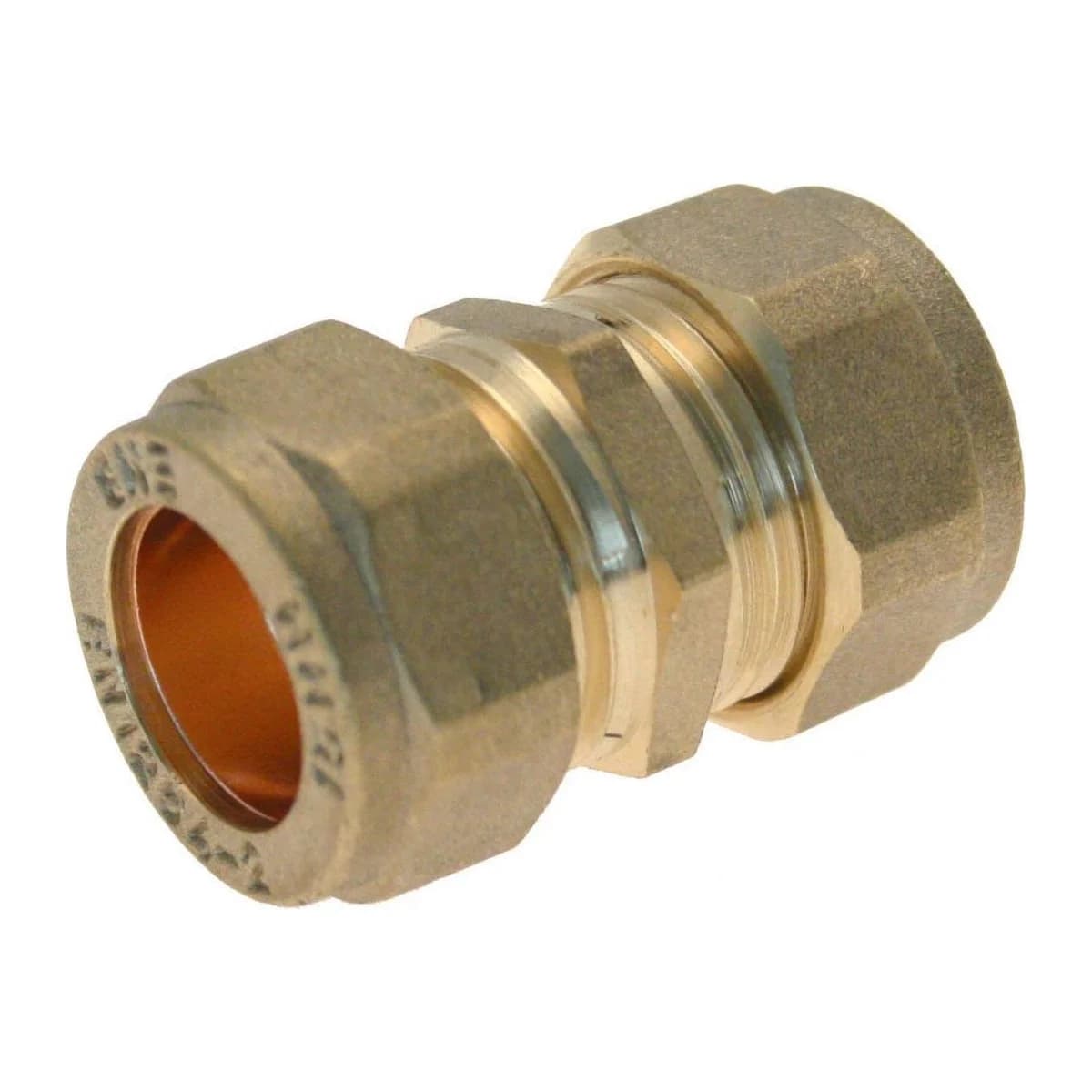 In stockCompact Compression Slip Coupler C x C
2 sizes available
Frominc VAT£2.58 ex VAT
✓ Delivery available✓ Collect today
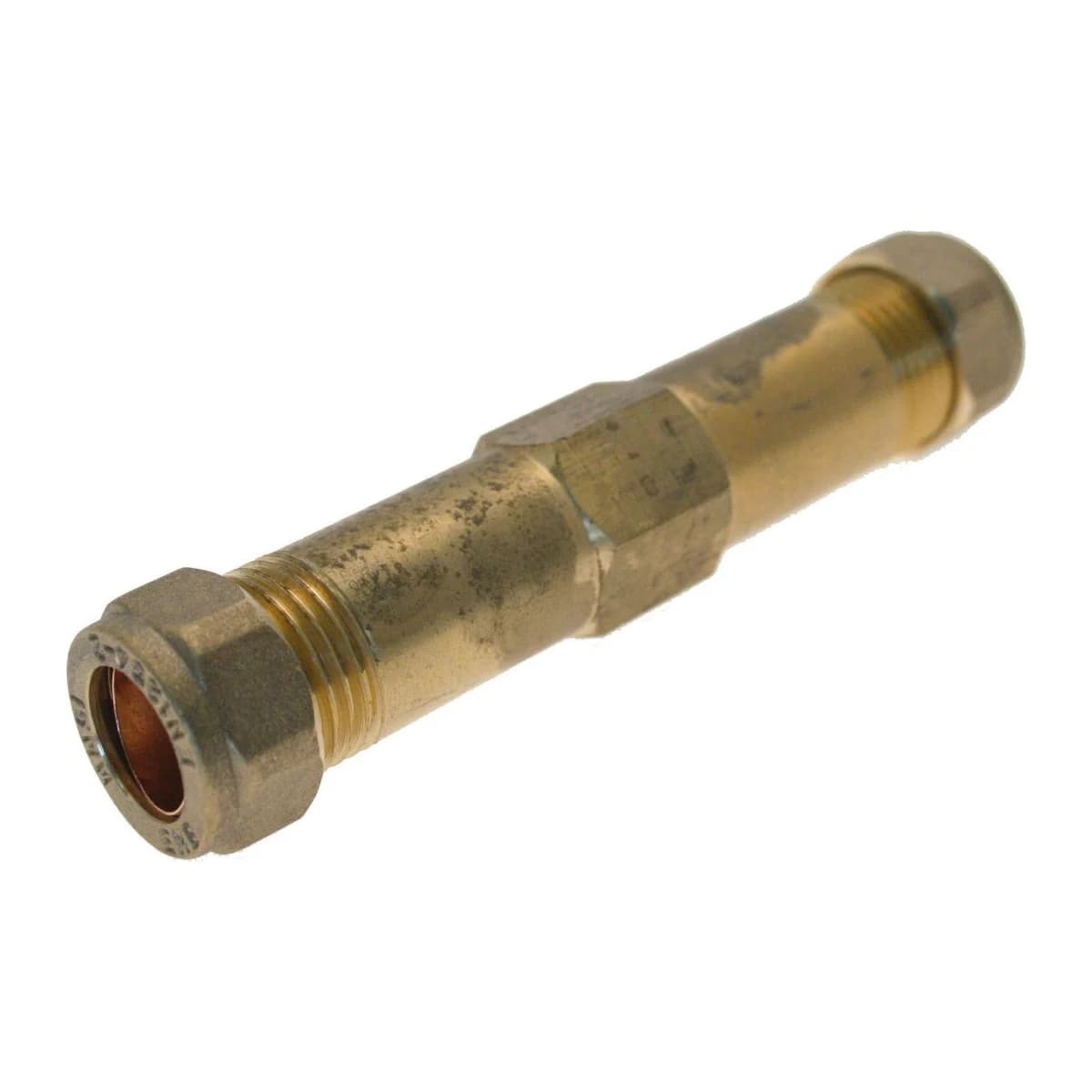 In stock15mm x 80mm Compact Compression Repair Coupler C x C
Code: LP-VEC3MP
inc VAT£4.44 ex VAT
✓ Delivery available✓ Collect today
Most push-fit couplers have a pipe stop, so in a fixed run they're usually used in pairs with a new length of pipe. On plastic pipe, always fit the pipe inserts the maker specifies. If you'd rather solder, end-feed slip couplers do the same job — but the pipe must be completely drained and dry for the solder to take.
How to fix a leaking compression joint
Most weeping compression joints are slightly loose, or their olive hasn't seated squarely.
- Hold the fitting body with one spanner and tighten the nut a quarter turn with another. Dry it and watch.
- Still weeping? Don't keep tightening — overtightening crushes the olive out of shape and makes the leak worse. Turn the water off, drain the pipe and undo the nut.
- Check the pipe went fully into the fitting, that it isn't oval or scored where the olive sits, and that the olive is square on the pipe.
- Re-olive. A compressed olive won't slide off. Use an olive puller (£38.80), or cut it carefully with a junior hacksaw without cutting into the pipe and twist it off — or, if there's enough slack, cut the end of the pipe off behind it.
- Fit a new olive of the same size. Many plumbers smear a little jointing compound on it or add a wrap of PTFE tape.
- Push the pipe fully home, tighten by hand, then about a half to three-quarters of a turn. Turn the water on and check.
Old imperial 3/4" pipe is bigger than 22mm, so it needs an imperial olive — we stock 22mm imperial olives. Compression vs push-fit vs solder explains how each joint works.
How to fix a leaking push-fit joint
Push-fit joints rarely leak if they're made properly. When one does, the usual causes are:
- The pipe isn't pushed fully home past the O-ring.
- Plastic pipe without an insert, so the pipe squashes under the grab ring.
- A pipe end cut at an angle or left with a burr, which can cut the O-ring.
- A scratched or scored pipe where the O-ring seals.
- A pipe pulling sideways on the fitting because it isn't clipped.
To fix it, turn off and drain the pipe, then release the fitting with the maker's release tool — each push-fit system has its own. Cut the pipe back past any marks with a square cut, deburr it, fit a new insert in plastic pipe, mark the insertion depth and push it fully home. If the O-ring or grab ring is damaged, replace the fitting, and follow the maker's rules on reusing fittings.
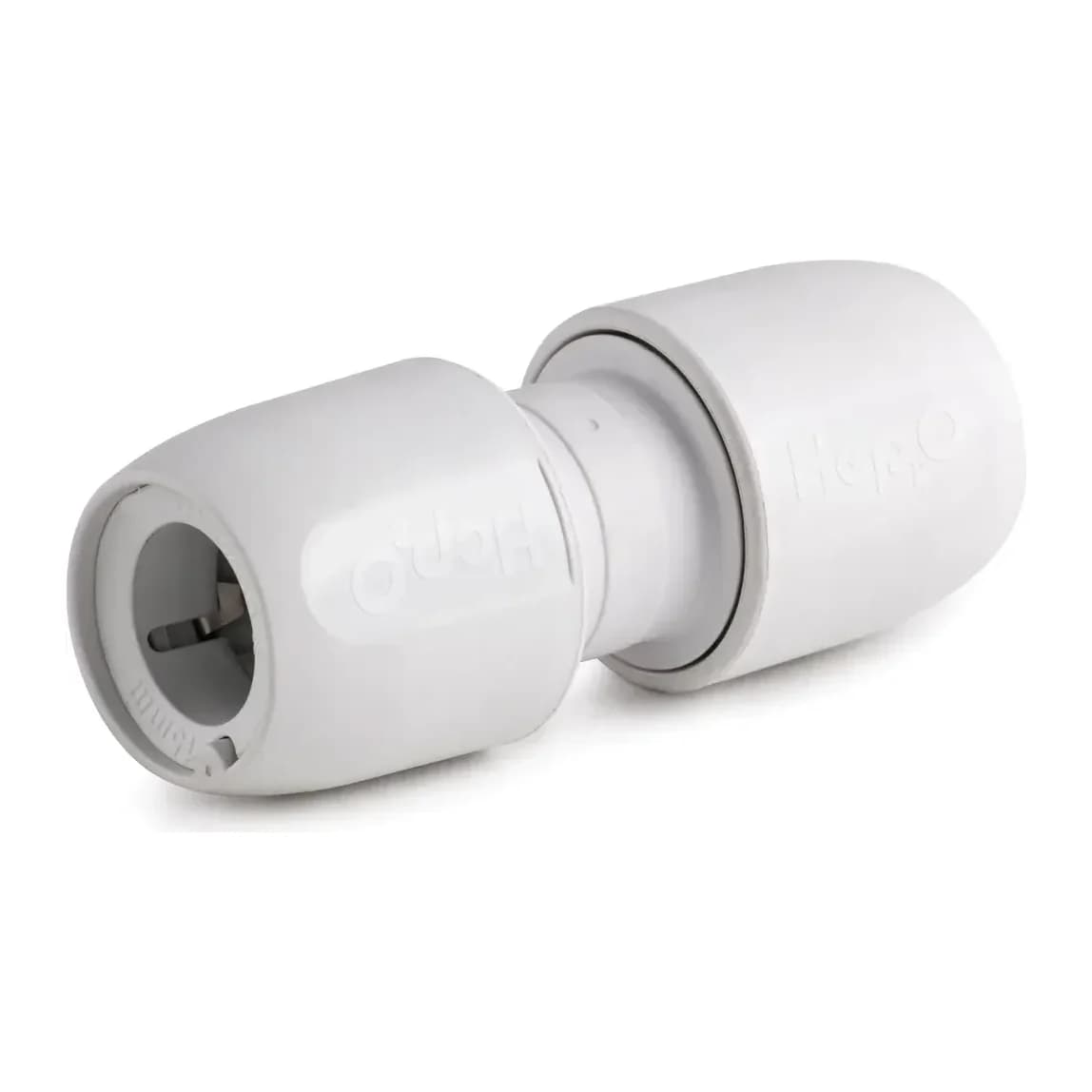 In stock
Hep2O
Hep2O Straight Connector HD12 options available
Frominc VAT£1.79 ex VAT
✓ Delivery available✓ Collect today
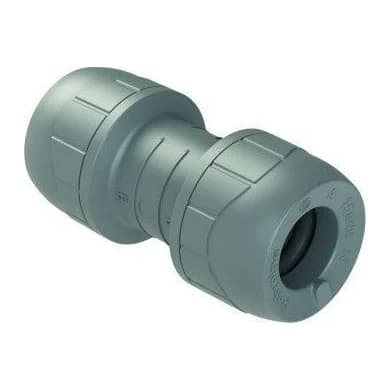 In stock
Polyplumb
Polyplumb Enhanced Coupler - Grey4 sizes available
Frominc VAT£1.99 ex VAT
✓ Delivery available✓ Collect today
- In stockCoupling Poly - Pack of 10
2 sizes available
Frominc VAT£16.17 ex VAT
✓ Delivery available✓ Collect today
Pinhole leaks in copper pipe
A pinhole is a tiny hole worn through the pipe wall, often showing as a fine spray, a slow drip or a green crust on the outside. Common causes are corrosion from the inside — around old joints where too much flux was left, or in heating systems running without inhibitor — and corrosion from the outside where copper is buried in concrete or screed without a sleeve.
Cut out the affected length and fit a coupler as above, but look closely at the pipe either side: where there's one pinhole there may be others, and a corroded run is better replaced than patched. On a heating system, check the water is treated — see the magnetic filter and inhibitor guide. For a pipe that split in a freeze, see how to stop pipes freezing.
When to call a plumber — or someone else
- Leaks inside walls, under floors or in ceilings you can't reach without opening them up.
- The supply pipe outside. You're usually responsible for the pipe between your property boundary and the house; outside the boundary it's your water supplier's — contact them.
- An unvented hot water cylinder, or water coming from its relief valve or tundish. Switch off the heating and hot water and call an installer qualified for unvented systems.
- Gas pipes, which are always a job for a Gas Safe registered engineer.
- Water near electrics that you can't make safe — call an electrician.
For call-outs in London, our sister company Capital Plumbing Group can help. For parts, bring the old fitting or a photo to our Chingford counter — see what to bring to the trade counter.
Questions
- What's the best temporary fix for a leaking pipe?
- Turn the water off and dry the pipe, then wrap it tightly in self-amalgamating tape or a repair bandage, or fit a bolt-on repair clamp. It will hold until you can cut out the damage and fit a coupler.
- Can you fix a leaking pipe without turning the water off?
- A wrap or clamp can slow a small leak under pressure, but most temporary fixes need a dry pipe to work. For a proper repair the water must be off — or the pipe frozen either side with a pipe freezer.
- How tight should a compression fitting be?
- Hand-tight, then about a half to three-quarters of a turn with a spanner, holding the body with a second spanner. If an existing joint weeps, try a quarter turn more before remaking it.
- Can you reuse a compression olive?
- An olive stays on the pipe once it's compressed, and can usually be re-tightened into the same fitting. If you're changing the fitting or the joint won't seal, cut the old olive off and fit a new one.
- Will PTFE tape stop a compression fitting leaking?
- Not on its own. The olive makes the seal, so a damaged or misaligned olive needs replacing. A little PTFE or jointing compound on a new olive can help it seat.
- Who is responsible for a leaking water pipe outside my house?
- Usually you are for the supply pipe between your property boundary and the house, and your water supplier is for the pipe outside the boundary. Contact your supplier if you're not sure where the leak is.
- Why does my push-fit fitting leak?
- Usually the pipe isn't pushed fully home, there's no insert in plastic pipe, or the pipe end is angled, burred or scratched. Release it, cut the pipe back square, deburr, fit an insert and push it fully in.