
The short answer
An expansion vessel gives the water in a sealed system somewhere to go as it heats and expands. Inside, a rubber diaphragm separates the water from a cushion of air or nitrogen at a set pre-charge pressure. Heating vessels, usually red, serve sealed central heating; potable vessels, usually blue or white, serve unvented cylinders and cold water systems. A flat vessel makes the pressure swing and the relief valve drip.
What does an expansion vessel do?
Water expands as it heats: a heating system's water grows by about 3% between cold and 80°C. In an open-vented system the extra water rises into the feed and expansion tank in the loft. A sealed system — a combi, a system boiler or an unvented cylinder — has no tank, so without somewhere to go the pressure would climb until the relief valve opened.
The expansion vessel is that somewhere: a steel tank split by a rubber diaphragm or bag. Water fills one side; the other holds air or nitrogen pumped to a set pressure, the pre-charge. As the water expands it pushes into the vessel and squeezes the gas, so the pressure rises gently instead of sharply.
Combi and system boilers have a vessel built in, inside the casing. Unvented cylinders have one on the cold supply, unless the cylinder holds an air bubble inside instead. Open-vented systems don't need one.
Heating or potable vessel: what's the difference?
| Heating vessel | Potable (drinking water) vessel | |
|---|---|---|
| Used on | Sealed central heating | Unvented hot water cylinders, booster pumps and cold water systems |
| Usual colour | Red | Blue or white |
| Water inside | Heating water with inhibitor — never drunk | Drinking water, so the membrane must be approved for it |
| Typical pre-charge | Around 1 bar, at or just below the system's cold pressure | The cylinder's pressure-reducing valve setting, often 3 or 3.5 bar |
Colour is a convention, not a rule — always read the label for what the vessel is for, its maximum working pressure and temperature, and its pre-charge. Never fit a heating vessel on a drinking-water supply: its membrane isn't approved for water you drink. On our shelf, heating and potable vessels are listed separately, by size.
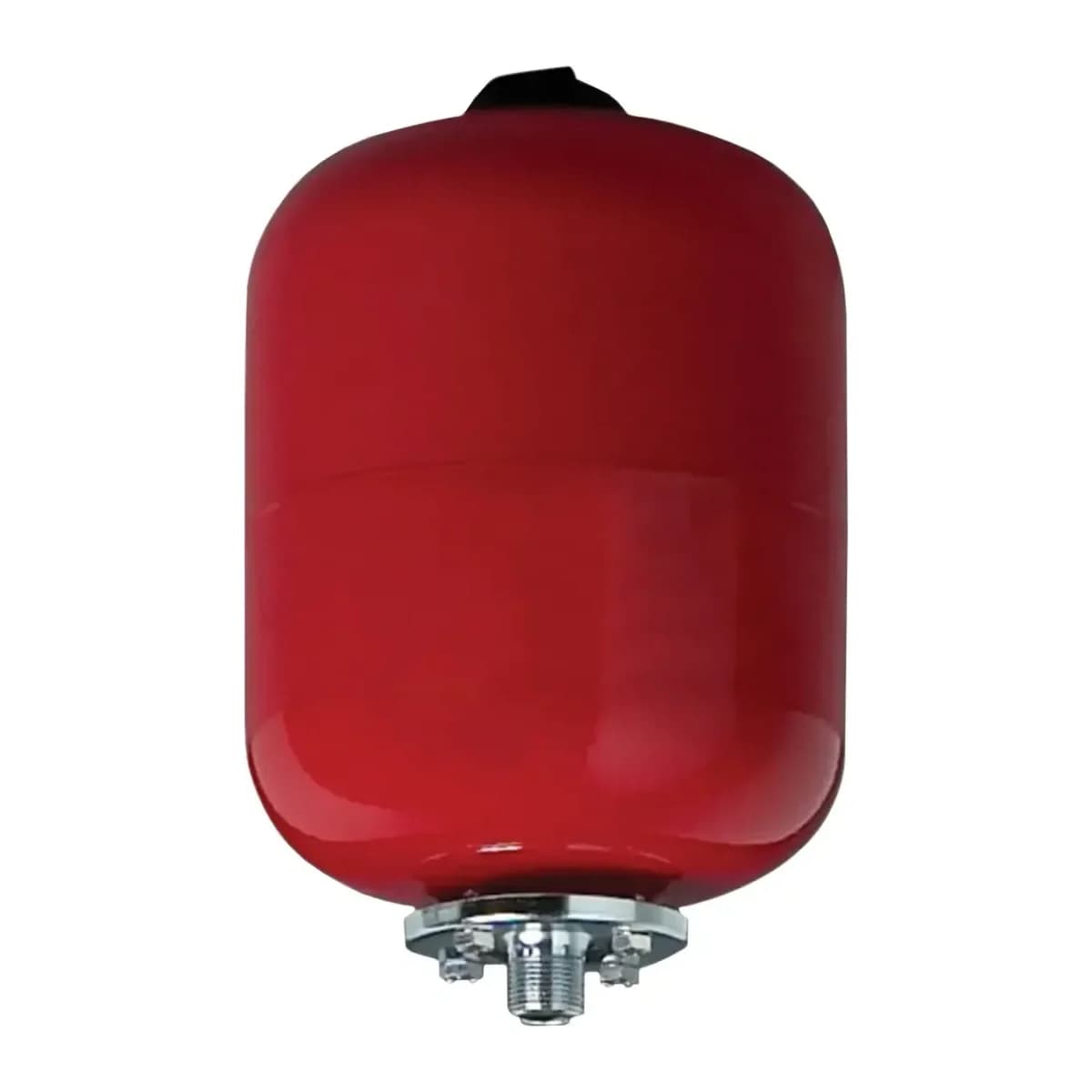 In stockRWC Aquasystem Expansion Vessels - Heating
10 sizes available
Frominc VAT£24.24 ex VAT
✓ Delivery available✓ Collect today
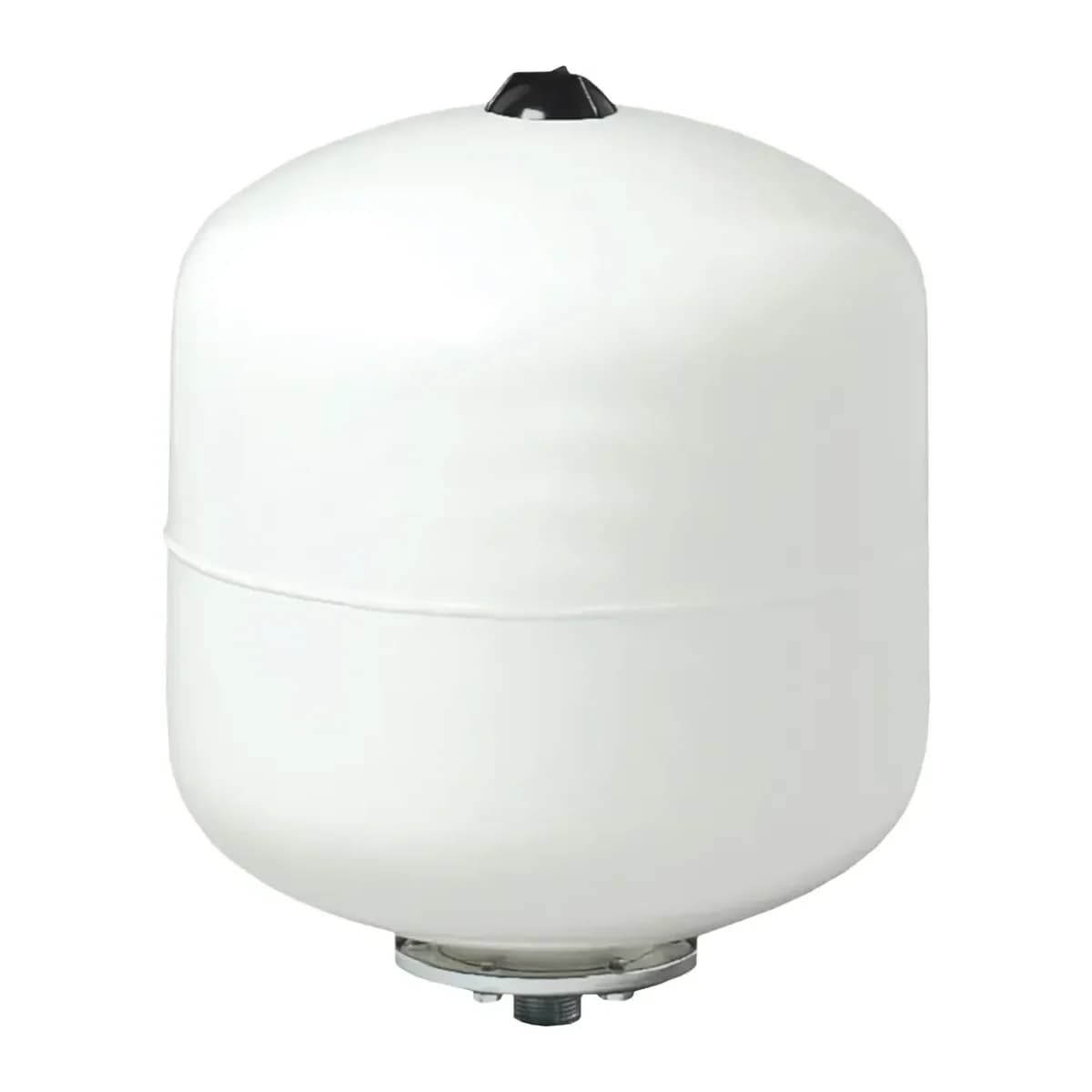 In stockRWC Aquasystem Expansion Vessels - Potable
7 sizes available
Frominc VAT£39.21 ex VAT
✓ Delivery available✓ Collect today
What size expansion vessel do I need?
The vessel has to take all the expansion without the pressure reaching the relief valve, so its size depends on how much water the system holds, the pre-charge and the relief valve setting. The vessel maker's sizing table gives the real answer.
As a rough rule of thumb, a heating vessel should be about a tenth of the system's water volume, with a 1 bar pre-charge and a 3 bar relief valve. Here's why: 100 litres of water heated to around 85°C grows by a little over 3 litres. With the gas starting at 1 bar and the pressure kept safely below 3, less than half of a vessel's volume can take water — so 100 litres of system needs a vessel of roughly 8 litres or more, and 10 litres leaves a margin.
| System water volume | Vessel, about |
|---|---|
| 50 litres | 5 litres |
| 100 litres | 10 litres |
| 150 litres | 15 litres |
| 200 litres | 20 litres |
| 300 litres | 30 litres |
Working out the water volume is the hard part. Add up:
- Radiators: makers' data sheets give each model's water content in litres.
- Pipes: roughly 0.06 litres per metre of 10mm microbore, 0.15 of 15mm copper, 0.32 of 22mm and 0.54 of 28mm.
- The boiler, cylinder coil, filter and any underfloor heating: from their manuals.
- Or measure it: read the water meter before you refill after a drain-down and again when you've finished, with nothing else running.
A combi's built-in vessel is sized for a typical home. If you've added radiators or underfloor heating, or the pressure now swings more than it used to, a heating engineer can add an external vessel on the return near the boiler. For an unvented cylinder, the maker specifies — and usually supplies — the vessel: replace it like for like.
How to check an expansion vessel's pre-charge
The pre-charge can only be read with the water side at zero pressure. With water pressing on the diaphragm, a gauge on the air valve just reads the system pressure, which tells you nothing. These steps are for external vessels; a vessel inside a boiler is checked by a Gas Safe registered engineer, usually at the service.
- Turn off the boiler, or the cylinder's heat sources, and let the system cool.
- Take the water side to zero. On a heating system, drain the pressure down — see how to drain a central heating system — or isolate and drain the vessel if it has its own valve. On an unvented cylinder, follow the cylinder's manual, which usually means turning off the cold supply and opening a hot tap.
- Take the cap off the air valve — a tyre-style Schrader valve, usually at the opposite end to the water connection — and read the pressure with a tyre pressure gauge.
- Pump it up with a foot or bicycle pump to the figure on the label or in the boiler or cylinder manual, or let air out if it's too high.
- If water comes out of the air valve, the diaphragm has split and the vessel needs replacing.
- Refill and re-pressurise the system, then check the gauge cold and hot.
A vessel that goes flat again within months usually has a leaking air valve or a failing diaphragm, and it's time to replace it.
Signs an expansion vessel has failed
- Big pressure swings. The gauge jumps a bar or more when the heating comes on, then falls back — often lower than before — when it cools.
- The relief valve discharges. A dripping pipe outside by the boiler, or water running into an unvented cylinder's tundish while it heats up.
- Constant topping up. Every time the relief valve opens, water is lost, so the cold pressure keeps falling — see why boiler pressure keeps dropping.
- Water from the air valve when you press its pin briefly: the diaphragm has failed.
Replacing or adding a vessel
- Match the type and the label: heating or potable, the volume, the maximum working pressure and the connection thread — check it against the one you're replacing.
- Set the pre-charge before fitting, with the vessel empty. New vessels come charged, but not always to the figure your system needs.
- Support it properly. A vessel full of water is heavy, so larger ones need a wall bracket rather than hanging on the pipe.
- Inside a boiler, it's an engineer's job. Replacing a combi's internal vessel means opening the casing, so it's for a Gas Safe registered engineer — some fit an external vessel instead of stripping the boiler down.
- On an unvented cylinder, the vessel is part of the safety equipment: replacing it is for a G3-qualified installer.
We keep 24 lines on the expansion vessel shelf — heating and potable vessels in a range of sizes, with brackets and fixing kits — plus pressure gauges and relief valves and tundishes.
Questions
- What pressure should an expansion vessel be?
- For heating, usually about 1 bar — at or just below the system's cold pressure. For an unvented cylinder, usually the inlet pressure-reducing valve's setting, often 3 or 3.5 bar. The label or the manual gives the exact figure.
- What's the difference between a red and a blue expansion vessel?
- By convention, red vessels are for heating and blue or white ones for drinking water, such as on an unvented cylinder. It's only a convention, so read the label to be sure.
- Can I use a heating expansion vessel on an unvented cylinder?
- No. The vessel on an unvented cylinder holds drinking water, so it must be a potable vessel approved for it, at the size and pre-charge the cylinder maker specifies.
- How do I know if my expansion vessel needs recharging?
- The pressure jumps when the heating comes on and falls when it cools, the relief valve drips, or you keep having to top up. Checking the pre-charge with the water side at zero confirms it.
- Can I recharge a combi boiler's expansion vessel myself?
- It's inside the boiler casing, so no — that's a job for a Gas Safe registered engineer, usually at the annual service.
- How often should an expansion vessel be checked?
- At the annual boiler or cylinder service. If the pressure starts swinging between services, have it checked sooner.
Related guides
- Heating & boilersVented vs Unvented Hot Water Cylinders: Which Do You Need?
- Heating & boilersHow to Drain a Central Heating System (and Refill It Properly)
- Heating & boilersCombi vs System vs Regular Boiler: Which Do You Need?