
The short answer
In England, Approved Document F asks for a bathroom fan to extract at least 15 litres a second (54 m³/h) when it's on. Most bathroom fans take 100mm (4") ducting. Choose an axial fan for a short run through a wall or window, and a centrifugal or inline fan for longer ducts. A timer or humidistat keeps it running until the steam has cleared. Check its IP rating suits the zone, and have an electrician fit and wire it.
How powerful does a bathroom extractor fan need to be?
In England, Approved Document F of the Building Regulations sets the minimum. A bathroom with an intermittent fan — one that runs when the room is in use — needs at least 15 litres a second, which is 54 m³ an hour. A fan that runs continuously at a low speed and boosts when the room is in use needs at least 8 l/s on boost.
| Room | Intermittent fan | Continuous fan, boost rate |
|---|---|---|
| Bathroom or shower room | 15 l/s (54 m³/h) | 8 l/s (29 m³/h) |
| Separate WC | 6 l/s (22 m³/h) | 6 l/s (22 m³/h) |
| Kitchen | 30 l/s with a cooker hood, 60 l/s elsewhere | 13 l/s (47 m³/h) |
It's the standard for new homes and for a bathroom added to an existing one, and the sensible target whenever you replace a fan. Wales and Scotland publish their own guidance, so check the local version there.
The rate has to be achieved as installed. A fan's brochure figure is usually measured with no ducting at all, and every metre of duct, every bend and the outside grille knock it down. So choose a fan rated comfortably above 54 m³/h, and higher again for a long run.
Timer, humidistat or pull cord?
- Timer (overrun): comes on with the light and keeps running for a set time after you switch it off. Approved Document F asks for at least a 15-minute overrun in a bathroom with no openable window. The simple, reliable choice for most bathrooms.
- Humidistat: switches on by itself when the air gets humid and off once it has cleared. Ideal for an en-suite used at odd hours, or where people forget the switch.
- Pull cord or separate switch: you decide when it runs. Cheap, but only as good as the person remembering — and forgetting is how mould starts.
- PIR movement sensor: comes on when someone walks in. Useful in a WC.
Timer and humidistat fans usually need a permanent live as well as the switched live from the light, and the electrician wires them through a fan isolator switch — a 3-pole switch that cuts every supply to the fan so it can be cleaned safely. We stock a satin chrome fan isolator.
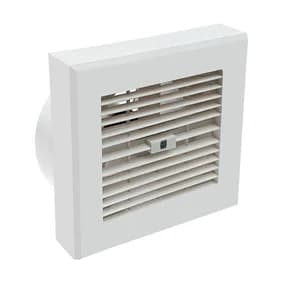 In stock
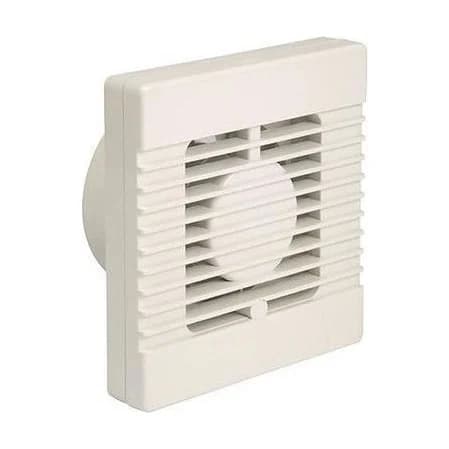 In stock
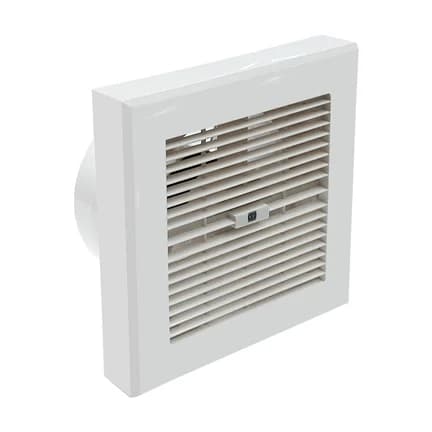 In stock
CED
Extractor Fan 6" with TimerCode: LP-1EK7WY5
inc VAT£23.07 ex VAT
✓ Delivery available✓ Collect today
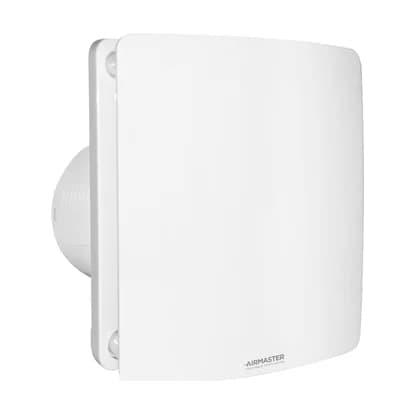 In stock
CED
6" Removable Front PNL EXT/ F with TimerCode: LP-UHJRVB
inc VAT£23.24 ex VAT
✓ Delivery available✓ Collect today
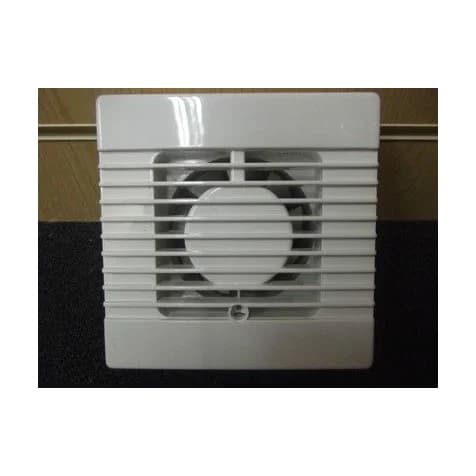 In stock
Manrose
Manrose Intervent Humidity Extractor Fan For Bathrooms & Toilets Nvf100h 4"Code: LP-3TTFF7
inc VAT£37.83 ex VAT
✓ Delivery available✓ Collect today
Axial, centrifugal or inline: which type of fan?
| Type | Where it goes | Best for |
|---|---|---|
| Axial | On the wall, ceiling or window, with a propeller blowing straight through | Short runs: straight through an outside wall or window, or a short duct |
| Centrifugal (radial) | On the wall or ceiling, with an impeller that builds pressure | Longer duct runs with bends, such as up through the ceiling and out of the loft |
| Inline (mixed flow) | In the loft or ceiling void, part-way along the duct | Long runs, quiet rooms, and over a shower, where only a grille is in the bathroom |
Axial fans move plenty of air but lose it quickly against the resistance of a long duct; centrifugal and inline fans hold their airflow much better. Whichever you choose, check the maker's maximum duct length.
Most bathroom fans are 100mm (4"); 150mm (6") fans are mainly for kitchens and larger rooms. Run the duct at the size of the fan's spigot all the way — never step it down to a smaller duct.
Ducting: diameter, length and condensation
- Keep it short and straight. Every bend and every metre adds resistance, so take the shortest route outside.
- Rigid beats flexible. Rigid round or flat-channel duct is smooth inside; flexible duct is ridged and slows the air, especially if it sags. If you use flexible duct, pull it taut and support it.
- Flat channel fits between ceiling joists or above kitchen units where round duct won't; use the matching round-to-flat adaptors.
- Always vent outside, through a wall grille, soffit or roof vent. Never into the loft, where the moisture condenses on the timbers and insulation.
- Stop condensation running back. In a cold loft, warm damp air condenses inside the duct. Insulate it, and give it a slight fall away from the fan so water drains outside rather than back into the fan.
- Fit a backdraught shutter or a gravity grille outside, so wind and cold air don't blow back in when the fan is off.
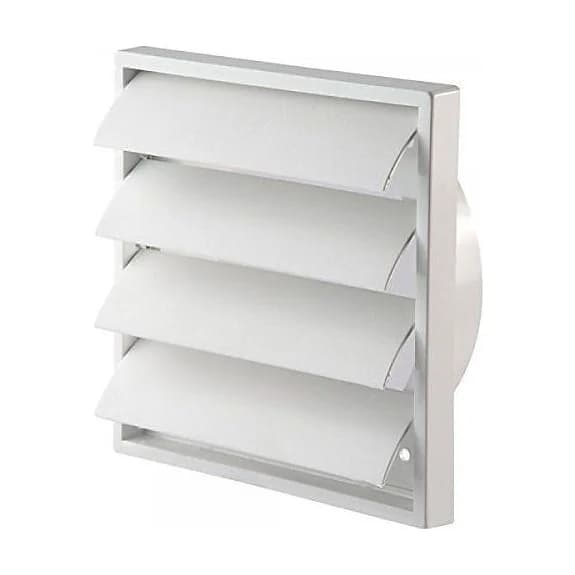 In stock
 In stock
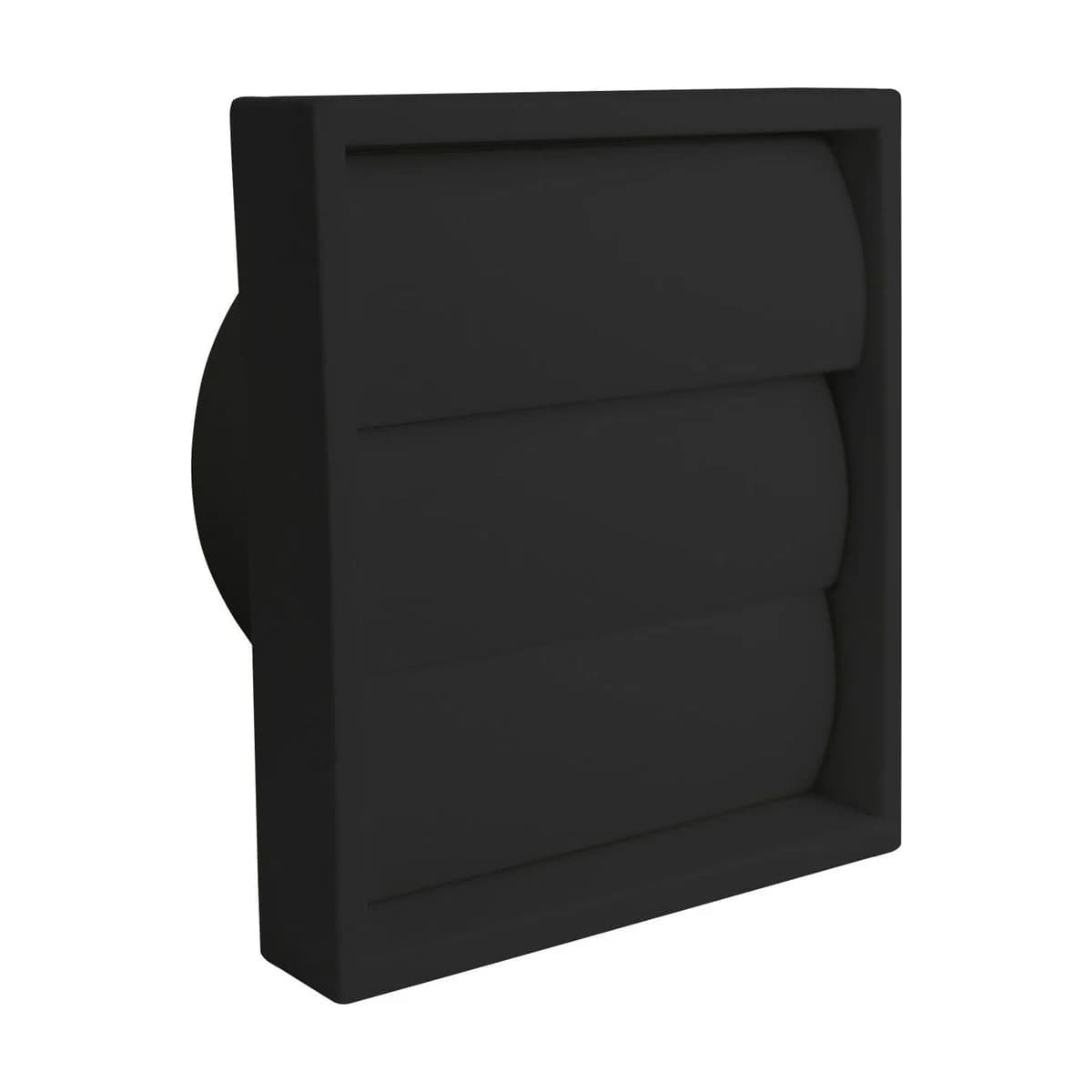 In stock1162BLK Gravity Shutter Grille 140 x 140mm Black
Code: LP-1GL85JP
inc VAT£4.53 ex VAT
✓ Delivery available✓ Collect today
 In stock
Replacement air has to get in, too. Approved Document F expects a gap under internal doors — about 10mm under a standard door, an area of 7,600mm² — so the fan isn't trying to empty a sealed room.
Bathroom zones and IP ratings for extractor fans
The wiring regulations, BS 7671, divide a bathroom into zones by how wet each part gets, measured from the bath or shower:
| Zone | Where it is | For a fan |
|---|---|---|
| Zone 0 | Inside the bath or shower tray | Never |
| Zone 1 | Directly above the bath or tray, up to 2.25m from the floor | IPX4 at least, and only if the maker allows it there; many only allow a 12V SELV version, with its transformer outside zones 0 and 1 |
| Zone 2 | Within 0.6m of the edge of zone 1, up to 2.25m | IPX4 at least |
| Outside the zones | The rest of the room | Fewer restrictions, but steam still reaches it |
The IP number measures protection: the first digit against solid objects, the second against water, so IPX4 means splash-proof from any direction, with solids not tested. Directly over the shower is the steamiest spot and the best place to clear it, but only a fan rated for zone 1 can go there. An inline fan neatly solves it: just a grille in the ceiling above the shower, with the fan itself up in the loft.
Every circuit in a bathroom also needs 30mA RCD protection under the wiring regulations; your electrician will check the existing installation has it.
Can you fit a bathroom extractor fan yourself?
Have an electrician fit and wire it. Electrical work in a bathroom has to meet BS 7671, and in England new work there — a new circuit, or adding to a circuit within the zones round a bath or shower — is notifiable under Part P of the Building Regulations. A registered electrician certifies it for you; anyone else has to involve building control before starting.
You can save the electrician time by agreeing the fan's position and cutting the hole and running the duct ready for them, as long as you check for hidden cables and pipes before you drill or core through a wall.
If you'd like us to arrange fitting in Greater London, electrics are talked through by phone: call 020 3802 3275.
Stopping condensation and mould
A fan clears the steam only if it runs long enough and has air coming in to replace what it takes out. Run it through every shower or bath and leave it on afterwards, keep the door undercut, squeegee the glass and tiles, and don't dry washing in the bathroom with the fan off.
Grout is where mould usually starts; PVC wall panels have none. A mirror demister keeps the glass clear but doesn't take moisture out of the room — see our LED mirror guide. In a wetroom, good extraction matters even more, because the whole floor gets wet.
Extractor fans and ducting on our shelves
We stock 9 extractor fans from £16.38, including 4" and 6" fans with timers and a Manrose humidity-controlled fan, plus 44 lines of ducting, vents and fittings.
Click & collect from our Chingford counter, usually ready in about an hour, or delivery anywhere in Great Britain — free over £250 ex VAT, otherwise £8.34.
Questions
- Is an extractor fan a legal requirement in a bathroom?
- For a new home or a newly added bathroom in England, yes: Approved Document F calls for extract ventilation, and an openable window alone doesn't meet it. No rule forces you to add one to an existing bathroom, but it's the best defence against mould.
- What size extractor fan do I need for a bathroom?
- Usually a 100mm (4") fan that moves at least 15 l/s (54 m³/h) once it's installed. Choose one rated comfortably higher if the duct is long or has bends.
- Can an extractor fan go above a shower?
- Only one its maker rates for zone 1, at IPX4 or better, and often a 12V SELV model with the transformer outside zones 0 and 1. An inline fan with a ceiling grille is another neat answer.
- Timer or humidistat: which is better?
- A timer suits most bathrooms: it runs on after the light goes off. A humidistat is better where the room is used at odd hours or people forget, because it reacts to the steam itself.
- How long should a bathroom fan run after a shower?
- At least 15 minutes in a bathroom with no openable window, says Approved Document F. Longer does no harm if the room is still steamy.
- Can I vent an extractor fan into the loft?
- No. It must discharge outside. Vented into the loft, the moisture condenses on the roof timbers and insulation, which leads to mould and rot.
Related guides
- Bathrooms & showersLED Bathroom Mirror Guide: Sizes, Demisters, Shaver Sockets and Wiring
- Bathrooms & showersPVC Shower Wall Panels vs Tiles: Which Is Better for Your Bathroom?
- Bathrooms & showersWetroom vs Walk-In Shower: Screens, Trays, Drains and Tanking
- Bathrooms & showersElectric vs Mixer vs Power Shower: Which Is Right for Your Hot Water System?