
The short answer
For a room you'll cool often, a wall-mounted split is better: the compressor sits outside so it's much quieter, the window stays shut, it uses less electricity for the same cooling, and a heat pump split heats in winter too. A portable costs less, needs no installer and moves between rooms, so it's fine for occasional hot spells, rented homes and rooms with nowhere for an outdoor unit. For several rooms, a multi-split runs up to three from one outdoor unit.
How does a portable air conditioner work?
A portable air conditioner is a complete air conditioner in one box on wheels: the compressor, both heat exchangers and the fans are all in the room with you. It cools the room's air and sends the heat it has collected — plus the heat from its own motor — outside through a wide hose, usually through a window kit that seals the gap around it.
Because the hot side has to vent outside, a portable can't work properly without its hose out of a window, a vent or a hole in the wall. The water it condenses from the air collects in a tank you empty, drains through a hose, or is evaporated into the exhaust air, depending on the model.
Single hose or dual hose?
A single-hose portable uses air from the room to cool its hot side, then blows that air out of the window. The air it throws out has to be replaced, so warm air from outside and from other rooms is drawn in through gaps around doors and windows — partly undoing the cooling.
A dual-hose portable draws outside air in through one hose to cool its hot side and sends it back out through the other, so it doesn't pull warm air into the room. For the same rated output, a dual-hose model generally cools a room better.
Either way, you'll get more from it if you:
- Keep the exhaust hose as short and straight as the instructions allow — it gets hot and warms the room.
- Seal the window gap with the window kit, and keep the room's door shut.
- Draw blinds or curtains on sunny windows, and switch it on before the room heats up.
- Size it generously: the hose and the part-open window cost it some of its rated cooling.
How does a split system work?
A split puts the noisy, hot half — the compressor and condenser fan — in an outdoor unit, and a slim fan unit high on the wall indoors. Two insulated copper refrigerant pipes, a cable and a condensate drain join them through a core hole in the wall, often 65mm across.
Indoors you mostly hear moving air: AURA quote an indoor sound pressure of 45 dB for their 12,000 BTU wall unit. Inverter compressors slow down once the room is cool rather than switching on and off. Every AURA split is a heat pump too, so it heats in winter — see air conditioning vs heat pump.
The catch is installation. The refrigerant circuit must be connected and commissioned by an F-gas certified engineer, the outdoor unit needs a sensible spot, and a larger unit may need its own electrical circuit. Our installation guide walks through it.
Portable vs split compared
| Portable | Wall-mounted split | |
|---|---|---|
| To buy | Lower | Higher, plus installation |
| Installation | None: plug it in and fit the window kit | F-gas certified engineer; an electrician if it needs a new circuit |
| Noise indoors | Compressor and fans in the room | Indoor fan only; the compressor is outside |
| Efficiency | Lower — the hot hose and open window let heat back in | Higher for the same cooling |
| Heating | Some models; check the spec | Yes, on heat pump models like AURA |
| Window | Open a little for the hose | Shut |
| Space | Takes floor space, near a window | On the wall, out of the way |
| Moving it | Wheels from room to room | Fixed |
| Condensate | A tank to empty, a drain hose, or evaporated | Drains outside, to a waste pipe, or through a pump |
| Permission | None | Planning and freeholder consent can apply |
Cost of ownership. A portable is the cheaper way in, but it uses more electricity for each hour of real cooling, and it's the one you'll want to replace if you start using it every day. A split costs more up front and less to run, and if you use it to heat in spring and autumn instead of plug-in heaters, it earns its keep all year. Over several summers of regular use the split usually comes out ahead; for a few hot days a year, the portable does.
Floor-standing and multi-split. For a large open space like a shop or gym, a floor-standing unit gives more output from one indoor unit; for two or three rooms, a multi-split runs them all from one outdoor unit. The indoor units share the outdoor unit's capacity, so the system is sized for the rooms together.
When is a portable air conditioner fine?
We sell split systems, but a portable is the right answer more often than you might think:
- A few hot days a year. If you only need cooling in a heatwave, a portable that lives in a cupboard the rest of the time is hard to beat on cost.
- Renting, or a flat where the freeholder won't allow an outdoor unit or a hole in the wall.
- Nowhere sensible for an outdoor unit — no suitable wall or ground, or the only spot is under a neighbour's bedroom window.
- Temporary needs, like a room during building work or a guest room used for a few weeks in summer.
- You need it this week. A portable works the day it arrives; a split needs an installer booked.
When is a split worth it?
- Bedrooms, where a compressor in the room makes sleeping hard.
- Home offices and living rooms you use every day through the summer.
- Top-floor flats, lofts and sunny extensions that overheat for weeks, not days.
- Rooms you'd also like to heat in spring and autumn without firing up the central heating.
- Shops, salons, offices and gyms, where cooling is part of running the business.
Size it with our air conditioner size guide, and see the air conditioning buying guide for noise, F-gas rules and what comes in the box.
The split systems we sell
We sell the AURA range of DC inverter heat pump splits — wall-mounted, floor-standing and multi-split — and the pipe kits, brackets and condensate pumps to install them. We don't sell portable air conditioners.
| Unit | Cooling | Heating | Typical room | Price |
|---|---|---|---|---|
| AURA 12,000 BTU Inverter Split Air Conditioner | 3.4 kW (11,601 BTU) | 3.4 kW | about 27–34 m² | £960.30 |
| AURA 18,000 BTU Inverter Split Air Conditioner | 5.1 kW (17,538 BTU) | 5.2 kW | about 41–51 m² | £1,158.36 |
| AURA 24,000 BTU Floor-Standing Air Conditioner | 7.0 kW (23,713 BTU) | 7.3 kW | about 56–70 m² | Call for price |
| AURA 24,000 BTU Inverter Split Air Conditioner | 7.2 kW (24,566 BTU) | 7.0 kW | about 58–72 m² | £1,381.80 |
| AURA Multi-Split Air Conditioner (27,000 BTU, 1–3 Rooms) | 7.9 kW (26,955 BTU) | 8.0 kW | about 63–79 m² | Call for price |
| AURA 45,000 BTU Floor Standing Air Conditioner | 13.5 kW (46,062 BTU) | 14.4 kW | about 108–135 m² | Call for price |
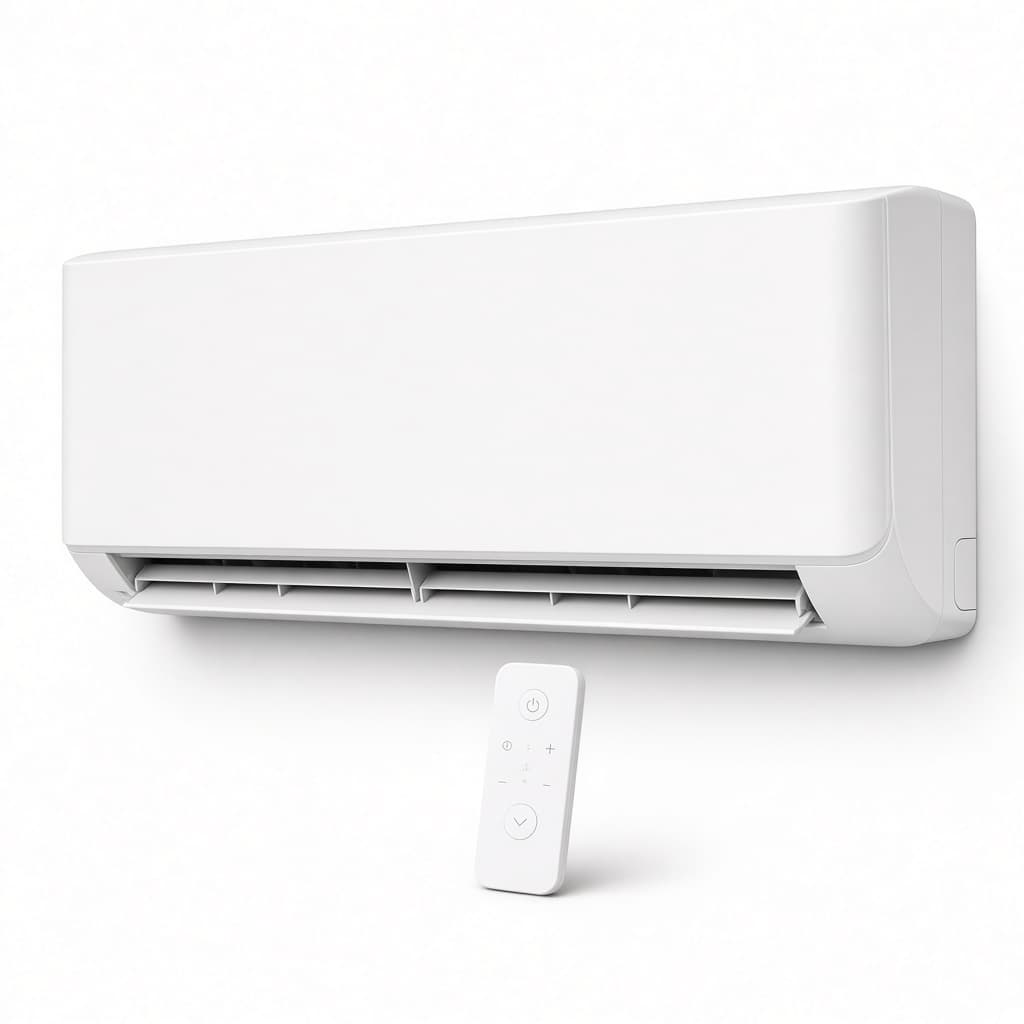 In stockBuy 2, get 10% offAURAAURA Inverter Split Air Conditioner
3 sizes available
Cooling 3.4 kW · Heating 3.4 kW
DC InverterR32Heating & coolingFrominc VAT£800.25 ex VAT
✓ Delivery available✓ Collect today
Each unit comes with 5 m of copper pipe, 5 m of interconnecting cable and a wireless remote. Installation isn't included: you'll need an F-gas certified engineer, and we can supply them the installation parts.
Questions
- Are portable air conditioners worth it?
- For occasional use, yes: they're cheaper to buy and need no installer. For a room you cool most days, a split is quieter, cheaper to run and doesn't need a window open.
- Why isn't my portable air conditioner cooling the room?
- Usually the hose: too long, kinked or not sealed at the window, so hot air leaks back in. Single-hose units also pull warm air in from outside. Check it's big enough for the room, keep the door shut and shade sunny windows.
- Can you use a portable air conditioner without a window?
- Only if the hose can vent outside another way, such as through a wall vent. Without venting outside it just moves heat around the room, and its motor makes the room warmer overall.
- Is a split air conditioner quieter than a portable?
- Much quieter indoors, because the compressor is in the outdoor unit. You mainly hear the indoor fan, which is quietest on its low setting.
- Can I install a split air conditioner myself?
- Not the refrigerant side. Connecting, pressure-testing and commissioning the refrigerant circuit must be done by an F-gas certified engineer. You can plan the positions and arrange the electrics and permission.
- Do you sell portable air conditioners?
- No. We sell AURA split systems — wall-mounted, floor-standing and multi-split — and their installation parts, online and from our Chingford counter.
Related guides
- Air conditioningWhat Size Air Conditioner Do I Need? BTU and kW by Room Size